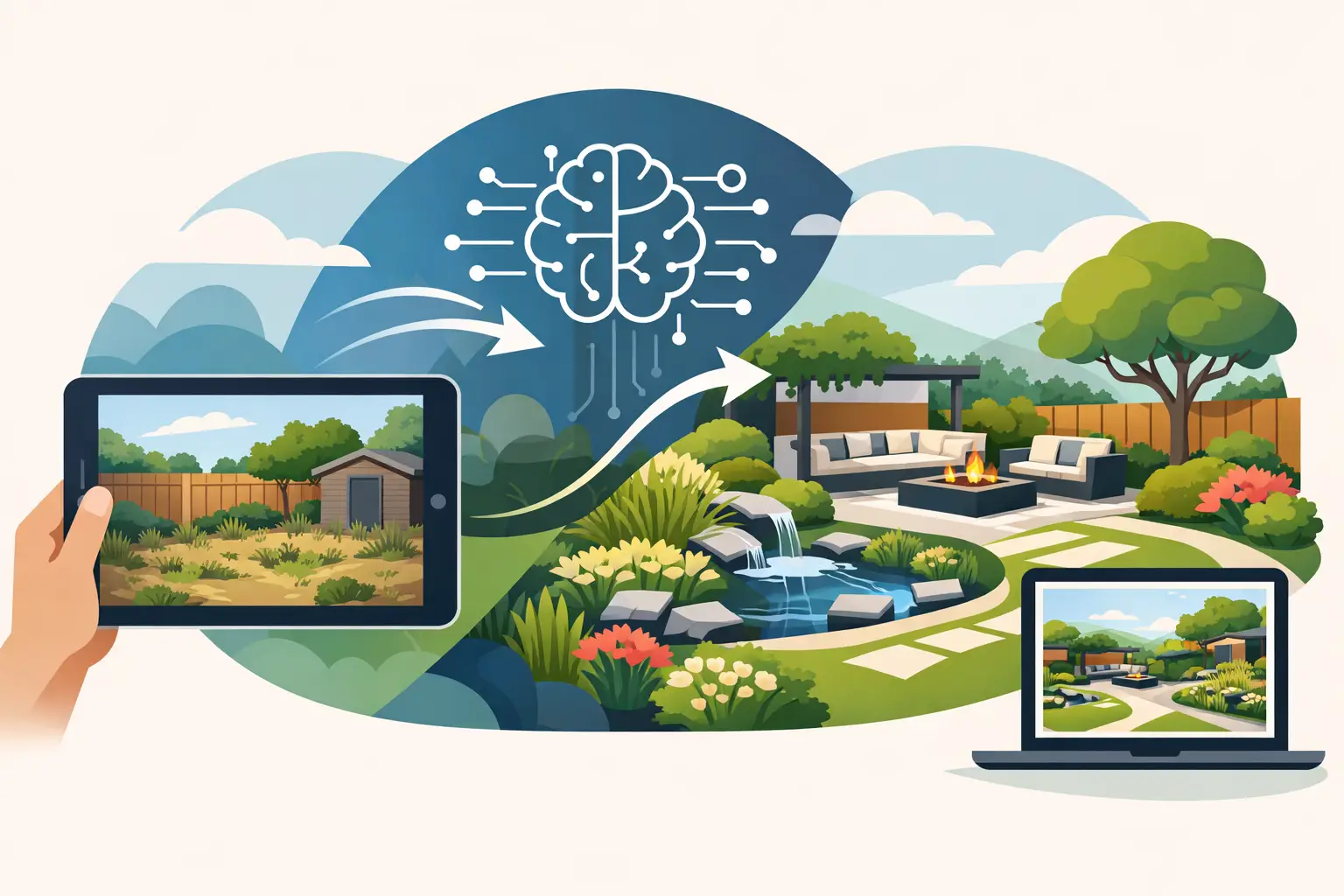
You don’t need a blank-sheet master plan to improve your yard. Most homeowners start with what they already have - a patchy front bed, an awkward patio edge, a side yard that never feels finished. That’s exactly where ai garden design from photo becomes useful. Instead of imagining changes from scratch, you can start with a real image of your space and see what different layouts, planting styles, and upgrades could actually look like.
This matters because outdoor projects get expensive fast. A few wrong plant choices, a bed that ends up too crowded, or a walkway that feels out of proportion can cost time and money to fix. Working from a photo gives you a faster, more grounded way to test ideas before you buy materials, dig holes, or commit to a full redesign.
Why AI garden design from photo is different
Traditional garden planning usually falls into two extremes. Either you sketch rough ideas and hope they translate in real life, or you hire a designer for custom plans before you know exactly what direction you want. A photo-based AI tool sits in the middle. It gives you a practical starting point that is visual, fast, and much easier to react to.
That visual feedback changes how people make decisions. It’s one thing to say you want "more structure" or "better curb appeal." It’s another to look at your own yard and compare a cleaner foundation planting, a more natural cottage-style border, or a modern low-maintenance layout. Once you can see possibilities on your actual property, your preferences get clearer.
There’s also a confidence factor. Homeowners often know what they dislike, but they struggle to picture what will work. AI can shorten that gap. You upload a photo, explore concepts, and narrow the field before making real-world choices about plants, edging, hardscaping, or outdoor living zones.
What a good photo-based garden design tool should help you do
Not every AI concept image is helpful. Some tools create pretty pictures that ignore how yards really function. A useful tool should do more than decorate an image. It should help you make decisions that hold up once you step outside.
At a practical level, ai garden design from photo should help you test layout ideas, compare planting styles, and understand scale. It should make it easier to answer real homeowner questions: Should this bed be deeper? Do I need more evergreen structure? Would a path improve flow through the side yard? Is this patio better framed by shrubs, ornamental grasses, or containers?
The best tools also support momentum. When inspiration strikes, you want to move quickly from “this area looks bad” to “here are three directions worth considering.” That speed matters, especially for DIY projects where hesitation often leads to another season of doing nothing.
How to get better results from your photo
The quality of the output depends partly on the quality of the image you start with. You don’t need professional photography, but you do want a clear, honest view of the space. Good daylight helps. A straight-on angle usually works better than an artsy shot taken from the corner of the yard. If you’re redesigning a planting bed, make sure the full bed is visible, including nearby features like the house, walkway, fence, or driveway.
It also helps to know what part of the space you’re trying to solve. Are you looking for more privacy, lower maintenance, stronger color, or a better entry sequence? AI works best when the goal is specific enough to guide the design direction. If you ask it to fix everything at once, the result may look polished without solving your biggest problem.
Season matters too. A winter photo can still be useful for structure and layout, but a summer photo may give better context for plant massing, shade, and how the space is currently performing. Neither is wrong. It depends on whether you’re evaluating bones or seasonal impact.
What AI can do well - and where it still needs your judgment
AI is strong at visualization. It’s fast at generating options and surprisingly good at helping people identify the style they want. It can also surface ideas you might not have considered, especially for transitions, bed shapes, and layering approaches.
Where it needs help is horticultural reality. A rendered design may look clean and balanced, but plants still need to match your climate, sun exposure, soil, and maintenance tolerance. A great-looking concept isn’t automatically a buildable one. That’s why the smartest use of AI is as a planning assistant, not a replacement for sound landscape judgment.
This is where expertise matters. If a tool is built with actual landscape knowledge behind it, the output is more likely to be useful in the real world, not just attractive on a screen. That’s a major difference between generic image generation and a landscape-focused app experience. Backyard Buddy is built around that practical gap - combining AI speed with decades of landscaping experience so the result is more than a visual mockup.
Best use cases for AI garden design from photo
Photo-based design is especially effective when the space already exists but isn’t working. Front yards are a perfect example. Many homeowners know their entry planting feels dated or sparse, but they don’t know whether to modernize, add color, simplify, or increase structure. Seeing those directions on a real photo makes the choice easier.
Backyards benefit too, especially when layout is the main issue. Maybe the lawn takes up too much space, the patio feels disconnected, or a corner of the yard could become a fire pit area, raised garden zone, or privacy screen. AI can quickly show different ways to organize the same footprint.
It also works well for smaller problem areas. Think mailbox beds, foundation plantings, side-yard transitions, pool surrounds, and patio borders. These are often too specific to justify full design services, but still important enough that homeowners want to get them right.
How to use the output without making expensive mistakes
The smartest approach is to treat the AI design as a working concept. If you like the direction, break it into decisions. Start with layout first. Then evaluate plant categories, hardscape elements, and finishing details. That step-by-step process keeps you from copying a concept image blindly.
For example, if the design shows layered planting, ask what that means in practice. Do you need evergreen anchors, flowering shrubs, and lower border plants? If it shows a more defined edge, decide whether that should be stone, metal edging, or a clean spade cut. If it introduces screening, think about mature size, maintenance, and how fast you need the coverage.
This is also the moment to pressure-test your budget. Some concepts are easy weekend upgrades. Others imply irrigation changes, drainage work, grading, lighting, or substantial hardscape investment. A strong design idea can still be right even if you phase it over time. You don’t have to build everything at once.
When photo-based design is enough - and when it isn’t
For many homeowners, a photo-based AI concept is enough to make confident progress. It’s often all you need to choose a style, improve layout, clarify planting direction, or communicate ideas to a contractor. That alone can remove a lot of guesswork.
But there are cases where you’ll want more than a concept image. If your project involves drainage issues, retaining walls, major grading changes, construction permits, or complex outdoor living installations, you may need site-specific planning beyond what an AI-generated design can provide. The same goes for highly technical planting challenges where local conditions matter a lot.
That’s not a weakness. It’s just the right boundary. AI is strongest when it helps you move from uncertainty to a clear, informed starting point. For most residential projects, that’s a major win.
Why this approach fits real homeowner behavior
Most people don’t begin with a full landscape master plan and a huge budget. They begin with one photo, one problem area, and one question: what should I do here? That’s why this technology is so practical. It matches how outdoor projects actually happen.
You notice the front bed looks tired. You want the backyard to feel more finished before summer. You’re tired of second-guessing plant choices at the garden center. A photo-based tool meets you at that point of friction and helps you turn a vague idea into a visual direction you can act on.
That’s the real value of ai garden design from photo. It doesn’t just make yards look better in an image. It helps homeowners make clearer, faster, more confident decisions in the spaces they live with every day.
A good yard plan shouldn’t feel like a gamble. Start with the space you have, test ideas visually, and let the next decision become obvious.