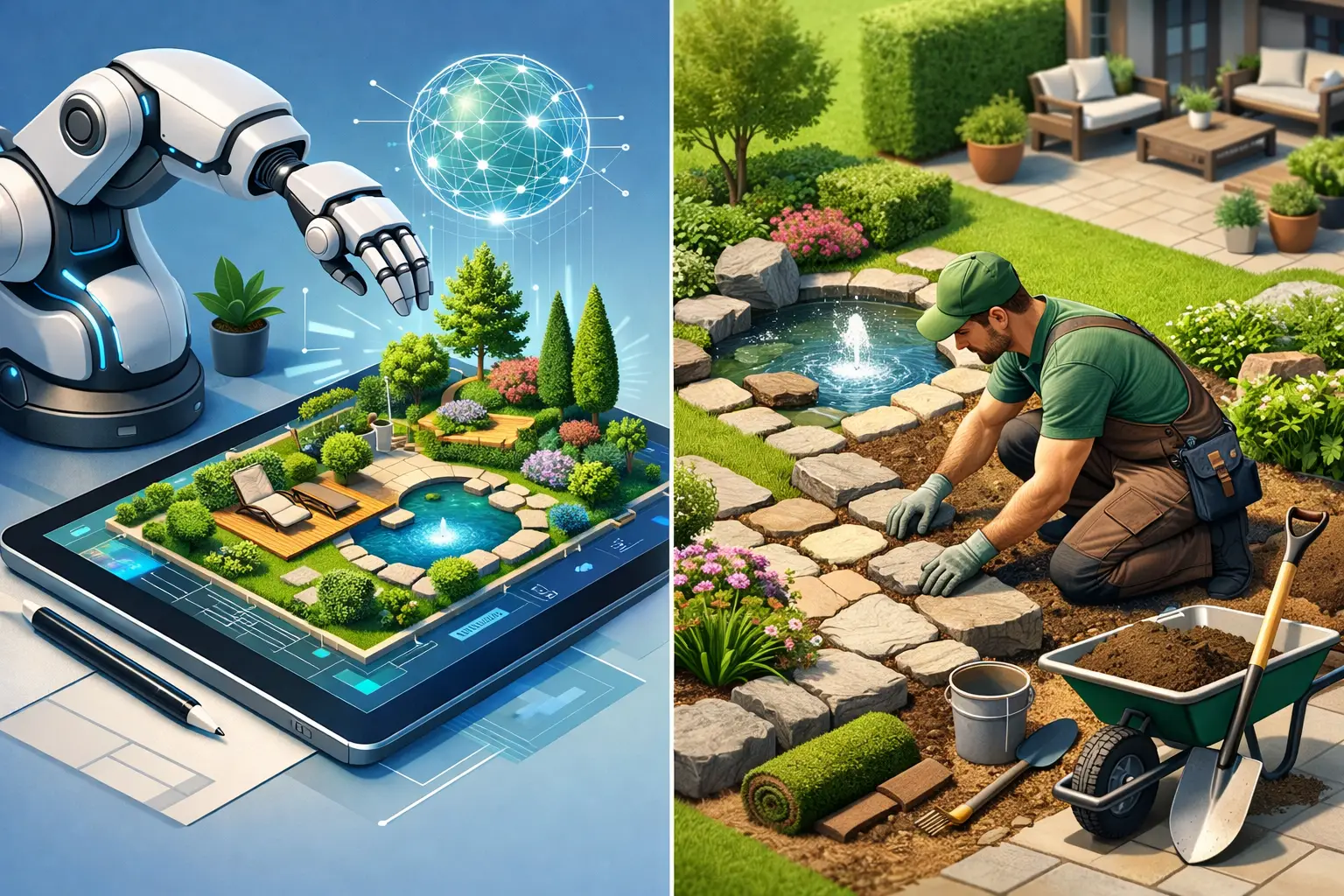
You do not need a five-figure landscape plan to figure out whether that patio should shift six feet left, which shrubs will survive your sun exposure, or why your yard still feels off. That is where the ai garden design vs landscaper question gets real for homeowners. Most people are not choosing between technology and expertise. They are choosing the fastest, smartest way to make better outdoor decisions without wasting money.
For some projects, a professional landscaper is absolutely the right call. For others, AI gives you enough clarity to plan with confidence, test ideas quickly, and avoid paying for custom design help before you even know what you want. The smart choice depends on the job, your budget, and how much guidance you actually need.
AI garden design vs landscaper: what is the real difference?
AI garden design is built for speed, visualization, and iteration. You upload photos, define your space, explore layouts, and pressure-test ideas without waiting days or weeks for a designer's first draft. It helps homeowners move from vague inspiration to a usable direction quickly.
A landscaper brings site judgment, construction knowledge, and hands-on accountability. A good one can identify drainage problems, grading issues, irrigation conflicts, code concerns, and installation realities that software alone may not fully capture. If the project involves excavation, retaining walls, structural hardscaping, or major planting investments, that matters.
The practical difference is not just who makes the plan. It is how decisions get made. AI helps you experiment early and often. A landscaper helps you validate and execute when the stakes are higher.
Where AI garden design is clearly better
If you are in the idea stage, AI usually wins on pure usefulness. Homeowners often need to compare styles, test bed shapes, rethink pathways, or see how a bare side yard could become something functional. That early planning work does not always require an on-site visit.
AI is also better when you want multiple directions fast. Maybe you are deciding between a low-maintenance front yard, a pollinator-friendly garden, or a backyard layout centered on entertaining. With digital planning tools, you can review options in the same afternoon instead of scheduling consultations and waiting on revisions.
Cost is another big factor. Hiring a landscaper for custom design can make sense on a large project, but it is often more help than a homeowner needs for a simple refresh. If your goal is to improve planting layout, visualize upgrades, or make smarter DIY decisions, app-based planning can deliver a lot of value before you ever pay for labor.
There is also a control advantage. Many homeowners want guidance, not a takeover. AI gives you room to shape the yard around how you live, what you want to spend, and how involved you want to be. You are not locked into a formal process before you are ready.
Where a landscaper still has the edge
There are projects where human expertise is not optional. If your yard has major slope issues, standing water, erosion, poor soil performance, tree-root conflicts, or complex irrigation needs, a landscaper's field experience is hard to replace. The same goes for projects involving permits, engineering, or structural elements.
A landscaper also adds value when installation risk is high. If you are about to spend heavily on mature trees, premium stonework, outdoor lighting, or a full backyard overhaul, mistakes get expensive fast. In those cases, expert oversight can save money by preventing bad placement, material missteps, or costly rework.
And then there is local judgment. Good landscapers know what routinely fails in a region, which plants are overused, how seasonal weather affects placement, and what looks good on paper but performs badly in real yards. AI can guide, but local experience still matters.
The cost conversation homeowners actually care about
When people compare ai garden design vs landscaper, they are usually asking one thing: what am I paying for?
With AI, you are paying for planning efficiency. You get visual support, idea generation, layout help, and faster decisions at a much lower cost than custom design services. That makes it a strong fit for homeowners who want to narrow choices, avoid bad guesses, and build a workable plan before spending on installation.
With a landscaper, you are paying for interpretation and accountability. They are not just producing a concept. They are reading the site, spotting problems, coordinating details, and in many cases connecting the design to actual construction. If your project is large or technically sensitive, that premium can be worth it.
The mistake is assuming one replaces the other in every scenario. A lot of homeowners overpay for full-service design when they only need planning clarity. Others underinvest in expertise on projects that truly need on-site judgment.
Speed vs depth: what matters more for your yard?
AI is faster. That is not a small advantage. Speed helps you keep momentum, compare options, and make progress while your ideas are still fresh. If you are the kind of homeowner who has screenshots saved for months but no actual plan, AI closes that gap.
A landscaper is usually slower, but often deeper. You may wait longer for appointments, drafts, revisions, and final direction. In return, you can get more project-specific advice tied to your property's conditions and build requirements.
The key question is whether your current problem is uncertainty or complexity. If you are stuck because you cannot picture the layout, AI is often enough to move you forward. If you are stuck because your site has real constraints, deeper expertise may be the better investment.
Accuracy depends on the type of decision
Not every yard decision carries the same risk. Choosing between two planting bed shapes is one kind of accuracy. Regrading around a foundation is another.
AI is highly useful for spatial planning, idea testing, and helping you see combinations you may not have considered. It is especially strong when the goal is to compare concepts, organize priorities, and create a plan you can act on.
A landscaper is stronger when accuracy depends on conditions that must be physically assessed. Drainage, soil behavior, construction tolerances, utility conflicts, and long-term installation performance often require in-person evaluation.
That is why the best comparison is not about which option is smarter overall. It is about which one is smarter for the decision in front of you.
The best choice is often both, in the right order
For many homeowners, the most efficient path is not AI or landscaper. It is AI first, landscaper second if needed.
That approach works because it reduces wasted time and vague conversations. When you use AI to clarify layout preferences, style direction, plant goals, and functional priorities, you show up with a more defined vision. That makes any later conversation with a landscaper more productive and often less expensive.
It also helps with DIY projects. Many people are fully capable of planting a bed, reshaping a border, improving a side yard, or planning a cleaner front entry once they can actually visualize it. An app like Backyard Buddy can make that early stage far more practical by combining AI speed with real landscape know-how, instead of forcing you to choose between guesswork and a full design contract.
How to decide what fits your project
If you are refreshing planting beds, rethinking layout, exploring backyard ideas, or trying to make a space feel more cohesive, AI is usually the better place to start. It is faster, more flexible, and easier on the budget.
If you are dealing with drainage, grading, construction, premium materials, or a full property transformation, a landscaper may need to lead. The bigger the installation risk, the more valuable hands-on expertise becomes.
If you are somewhere in the middle, start with the tool that helps you define the problem. Many outdoor projects stall because homeowners are paying for answers before they have framed the right questions.
The goal is not to prove that technology beats professionals or that traditional landscaping is outdated. The goal is to make better yard decisions with less friction. If AI helps you see the space clearly, that is progress. If a landscaper helps you avoid a costly mistake, that is progress too. The right choice is the one that gets your yard from uncertain to workable, without adding more complexity than the project actually needs.