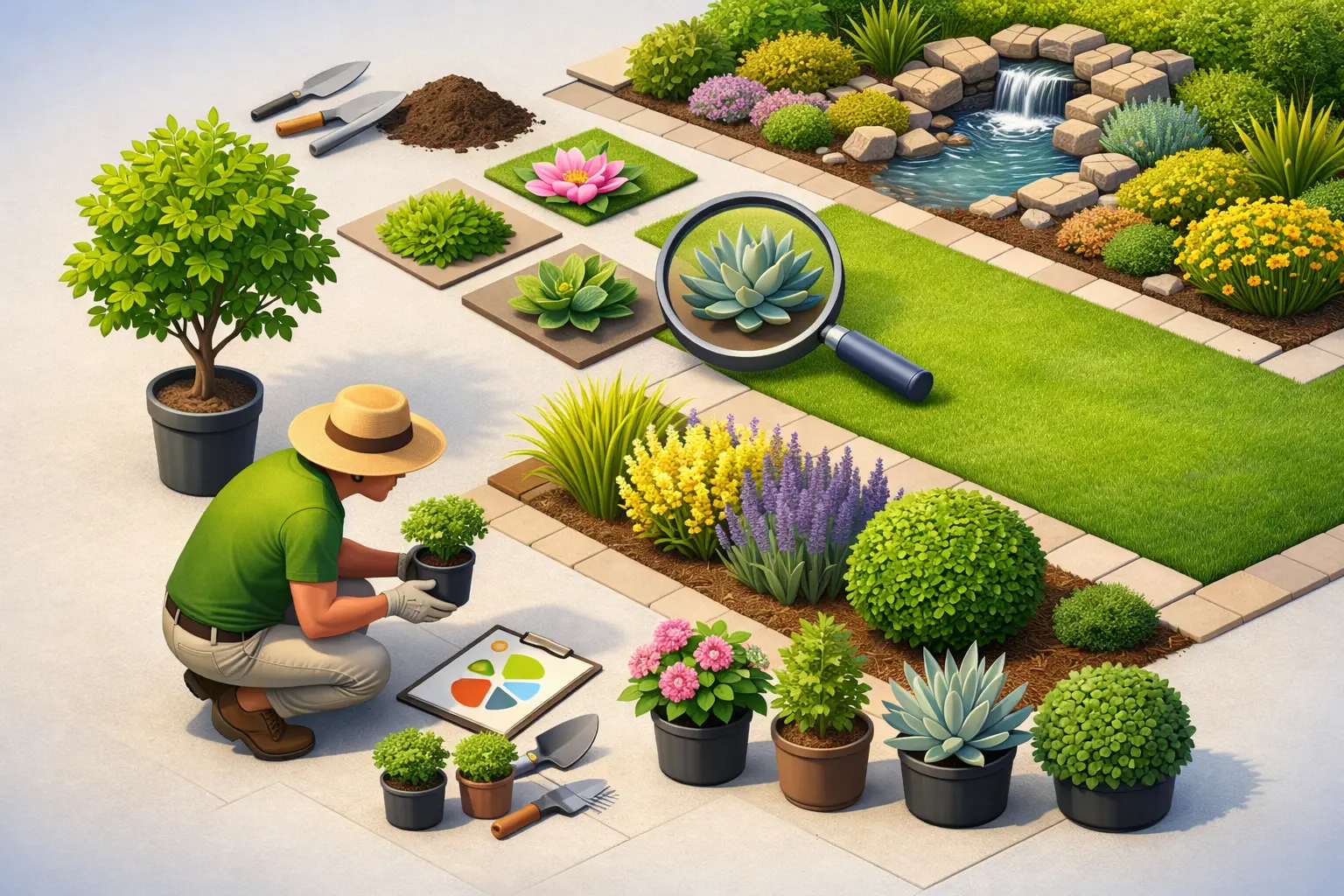
Most plant mistakes start before anyone digs a hole. A shrub looks great at the garden center, a flowering tree catches your eye, or a fast-growing evergreen seems like a quick fix. Then a year or two later, it is blocking a window, struggling in the wrong light, or needing far more water than the rest of the yard. If you are figuring out how to choose landscape plants, the goal is not to find the prettiest plant. It is to find the right plant for the exact job, space, and conditions you have.
That sounds simple, but this is where many homeowners lose time and money. Good plant selection is part design decision and part site analysis. When those two parts work together, your landscape looks better, needs less maintenance, and performs more predictably over time.
How to choose landscape plants by starting with the site
Before you think about color, bloom time, or style, look at the yard like a planner. Plants are not decor you add at the end. They are living material, and the site decides what has a real chance to thrive.
Start with sunlight. A spot that gets six or more hours of direct sun is very different from an area with morning light only, or a bed shaded by a fence and mature trees. Many planting failures happen because "partial sun" gets interpreted too generously. If a plant tag says full sun, assume it means it wants strong, reliable light, not just a bright location.
Next, pay attention to drainage. After a heavy rain, some areas dry quickly and others stay wet for days. That matters more than many people expect. A plant that prefers well-drained soil can fail in a low spot even if everything else seems right. On the other hand, moisture-loving plants often struggle in hot, dry strips near driveways or foundations.
Soil also matters, but not in a perfectionist way. You do not need laboratory-level analysis for every planting bed. You do need a basic read on whether your soil is sandy, dense clay, rocky, or reasonably balanced. That gives you a more accurate sense of how often you will need to water and which plants are likely to adapt.
Then look up and out. Power lines, roof overhangs, sidewalks, foundations, pool decks, and neighboring plants all affect what belongs where. The right plant in the wrong location still becomes the wrong plant.
Match plants to a purpose, not just a look
One of the fastest ways to improve plant decisions is to define what each area of the yard needs to do. A front foundation bed has a different job than a privacy screen, pollinator border, or poolside planting area.
If you need structure, look for plants with dependable shape and strong seasonal presence. If you need screening, focus on mature width, height, and density, not just growth speed. Fast-growing plants can solve one problem and create another if they outgrow the space or become weak and messy.
If your goal is color, think beyond a single bloom season. Some homeowners load a bed with spring flowers and end up with a landscape that feels flat for the rest of the year. A better approach is to layer interest - foliage color, bloom timing, texture, bark, seed heads, or evergreen form. A planting can still feel lively even when nothing is in peak flower.
For high-use spaces, practicality matters even more. Around patios, walkways, and entry points, choose plants that do not constantly drop messy fruit, grab ankles with thorns, or grow aggressively into traffic paths. Near pools, lower litter is often a better choice than dramatic flowering plants that shed heavily.
Size at maturity is where smart plans win
If there is one rule worth taking seriously, it is this: buy for the mature size, not the container size. Small plants can be deceptive. That tidy three-gallon shrub may eventually want to be six feet wide. That ornamental tree may look perfectly placed now and become a pruning problem later.
This is where patience beats impulse buying. Plants spaced too tightly can look full right away, but they often become crowded, unhealthy, and maintenance-heavy. Plants given room to mature naturally tend to look better and need less correction.
Height matters, but width causes just as many problems. People often remember to keep tall plants away from windows, yet forget how much a shrub can spill over walkways or press into siding. When planning, picture the plant five to ten years from now, not on planting day.
Climate and hardiness are the baseline, not the whole answer
USDA hardiness zones are useful, but they are only the starting point. A plant may technically survive winter in your zone and still struggle with summer heat, humidity, wind exposure, or drought.
That is why local performance matters. A plant that thrives in one part of the country may behave very differently somewhere else, even within the same zone range. Regional weather patterns, disease pressure, and rainfall make a big difference.
Native and climate-adapted plants are often smart choices because they tend to fit local conditions more naturally. That does not mean every landscape needs to be exclusively native. It means your plant palette should make sense for where you live and how much intervention you want to provide. If you want a lower-maintenance yard, choose plants that already like your climate instead of trying to force a high-maintenance favorite to survive.
How to choose landscape plants for maintenance level
Every homeowner says they want a beautiful yard. Fewer people think clearly about how much upkeep they actually want to commit to in July.
This is where honest planning saves frustration. Some plants need regular trimming to hold their shape. Others drop petals, pods, berries, or leaves in ways that look charming in theory and annoying in practice. Some are thirsty. Some are disease-prone in certain regions. Some grow so vigorously they turn into a constant editing job.
There is no perfect low-maintenance plant, but there are better maintenance matches. If you want a cleaner, simpler landscape, lean toward durable plants with strong natural form, reliable disease resistance, and moderate growth rates. If you enjoy gardening as a hobby, you may be happy to include fussier plants in high-visibility areas where the extra effort feels worth it.
The key is consistency. A low-water planting plan mixed with a few high-water plants usually creates inefficient watering and uneven performance. A low-maintenance design filled with plants that need constant shaping is not really low-maintenance. Your plant choices should support the lifestyle you actually have.
Style still matters, but it should work with the house
Good plant selection is not just about survival. It is also about visual fit. The landscape should feel connected to the architecture and the way you want the yard to function.
A formal home often pairs well with cleaner plant forms, repeated masses, and more structure. A casual or naturalistic home can handle looser layering and softer plant combinations. Modern landscapes usually benefit from restraint - fewer varieties, stronger forms, and simpler color choices.
That said, style does not need to become a rulebook. The bigger point is cohesion. Too many unrelated plant choices can make even healthy landscaping feel scattered. Repeating a smaller number of plants often creates a cleaner, more confident result than collecting one of everything you like.
Avoid the common plant selection traps
Most expensive mistakes are predictable. Choosing only by flower color is one. Ignoring mature size is another. So is installing a plant because it looks healthy at the nursery without checking whether your yard can support it.
Another common issue is overreacting to speed. Fast growth sounds appealing when you want privacy or instant impact, but faster is not always better. Quick growers can be weaker wooded, shorter lived, or more demanding to maintain. Slow-to-moderate growers often create better long-term structure.
It is also easy to underestimate microclimates. The south-facing bed near a brick wall may be much hotter and drier than the side yard. The corner by a downspout may stay wetter than the rest of the property. Treating the whole yard as one set of conditions leads to sloppy plant matching.
And then there is the temptation to buy first and plan later. That usually produces a landscape made of individual good ideas that do not work together. A smarter process is to map the space, identify the conditions, define the function, and then choose the plants that solve the problem.
Use tools that make plant decisions easier
You do not need to guess your way through plant selection anymore. Visual planning tools can help you test layout ideas, compare plant spacing, and see how beds relate to patios, walkways, and the house before you start planting. That matters because plant choice is rarely isolated. It affects sightlines, maintenance, balance, and how the whole yard feels.
This is also where practical tech can shorten the learning curve. An app like Backyard Buddy can help homeowners move from vague inspiration to more informed decisions by combining design support with plant guidance in one place. That is especially useful if you are balancing aesthetics with real-world constraints like sun, spacing, and function.
The best landscapes rarely come from picking the most exciting plant. They come from making a series of solid decisions that fit the yard, the home, and the way you actually live outside. Choose plants that belong where you put them, and your landscape will do more of the work for you.