7 min lesson · by Linda
Sleep, Creep, Leap: What to Expect the First 3 Years
Why a brand-new landscape looks underwhelming, what each year really looks like, the two-summer watering rule, and the mistakes that kill new plantings.
Why your new landscape looks… underwhelming
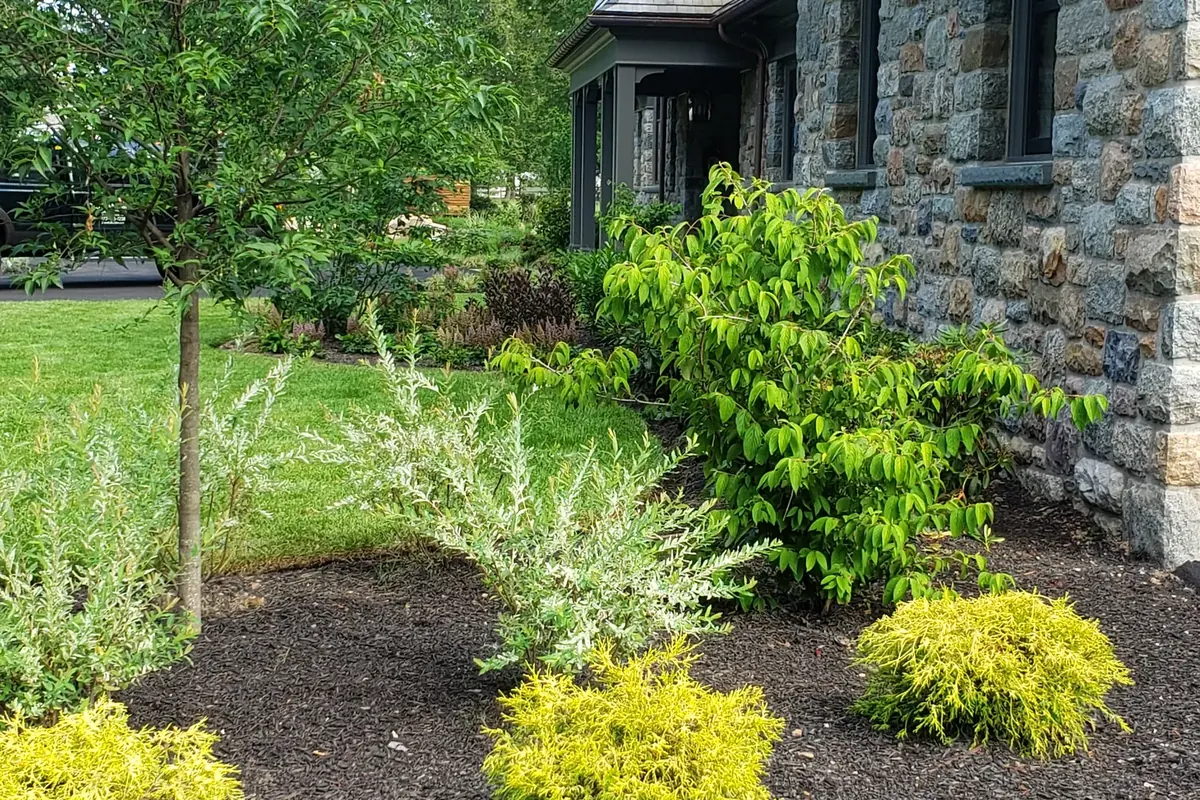
Every client I've ever planted for has had the same look on their face the week after installation: a polite smile that says "I paid for THIS?" Small plants. Lots of mulch. Gaps you could park a wheelbarrow in. I promise you, that sparse look is the sign of a landscape done right — those plants were spaced for the size they'll be in five years, not the size they are today.
Here's the rule I've repeated more than any other in 38 years: the first year new plants SLEEP, the second year they CREEP, the third year they LEAP. Understand that rhythm and you'll stop panicking in year one, stop over-fussing in year two, and be standing in a full, lush garden by year three wondering where all the mulch went.
Linda's Tip 🌿
Take a photo of every new bed the day it's planted, from the same spot, and again each June. By the third photo you won't believe it's the same yard — and you'll have proof for the next impatient homeowner (often yourself).
Year one: SLEEP — it's all happening underground
In year one a plant is doing the most important work of its life and none of it is visible. A nursery shrub arrives with a root ball the size of its pot — a fraction of the roots it needs. Its whole first season goes into pushing roots out into your soil. Top growth is minimal, flowers are sparse, and some plants (hydrangeas, I'm looking at you) look faintly offended all summer. Normal. All of it.
Your only job in year one is water. Not fertilizer, not pruning, not moving things around. Water. A new tree or shrub needs a deep soak once a week — 5 to 10 gallons for a shrub, 15 to 20 for a tree — through the whole growing season, and a deep drink before the ground freezes. Perennials and groundcovers want the same weekly soak but less volume. Sprinklers that run for 10 minutes and wet the mulch do not count; water needs to reach the bottom of the root ball.
Skip the fertilizer entirely the first year. Fertilizer pushes leafy top growth the roots can't support yet — you get a lush plant that collapses in the first heat wave. Compost on top is fine. A bag of 10-10-10 is not.
Linda's Tip 🌿
Beginners: never fertilize in the hot sun. Fertilizer plus heat equals burned roots and scorched leaves. When you do feed — starting year two — always time it for the evening, on soil you've already watered.
Year two: CREEP — growth you can finally see
Year two the roots are established enough to support real growth. Shrubs put on 4 to 8 inches, perennials double in width, trees start pushing out new branches, groundcovers begin knitting together. It's still not the finished picture — but it's the first year you'll catch yourself saying "oh, look at THAT."
Keep watering through the second summer — the two-summer watering rule is non-negotiable. Year two is also when you start light feeding (an organic slow-release in spring, evenings only), refresh mulch to 2–3 inches, and do the first shaping cuts on shrubs that need it. Perennials that flopped last year can be pinched back in late May to stay compact.
Year three: LEAP — the landscape you paid for
Year three the plants take off. Shrubs fill their gaps, perennials become clumps that need dividing, grasses hit full height and flower, the tree throws real shade for the first time. This is when strangers slow down driving past. It's also when you finally see which plant is too close to the walkway, which hydrangea wanted more sun, and what needs editing — every good landscape gets a year-three tweak.
From year three on, established trees and shrubs mostly water themselves except in drought. Perennials get divided every 3–4 years (spring for summer bloomers, fall for spring bloomers). Mulch shrinks to a light annual top-up as the plants shade the soil themselves. You've gone from gardener to caretaker.
Transplant shock vs. a truly dead plant
Wilting the first week, a few yellow leaves, dropped blooms, a slow start — that's transplant shock, and almost every plant goes through it. Keep watering on schedule (don't drown it in panic), shade it with a lawn chair in a heat wave, and give it three weeks before you judge. Evergreens are the exception: they can be dead for months and still look green, so watch them closely through the first winter.
Here's my test: scratch a pencil-eraser-sized spot on a stem with your thumbnail. Green underneath means alive — leave it be. Brown and dry means that stem is gone. Check three spots, low on the plant. If the base is green, it will very likely re-sprout from lower down. A brown, brittle, hollow-sounding trunk is the only real death certificate.
Linda's Tip 🌿
Most "dead" plants I'm called to look at in June are drowning, not dying of thirst. Push a finger 3 inches into the soil beside the root ball before you water. Cool and damp? Skip it. Only water when it's dry at finger depth.
The five mistakes that kill new landscapes
One: shallow, frequent watering — a sprinkle every day teaches roots to stay at the surface where they fry. Water deep, water weekly. Two: the mulch volcano — mulch piled against a trunk rots the bark and invites voles; make a donut with 3 inches of clearance. Three: year-one fertilizer, especially in hot sun. Four: planting too deep — the root flare (where trunk widens into roots) must sit at or slightly above soil level, and burlap and wire baskets come OFF the top of the ball. Five: pruning to "balance" the plant at planting time — those leaves are the solar panels that feed the new roots. Cut only broken branches the first year.
Avoid those five, follow the two-summer watering rule, and I can almost guarantee the leap. The plants know what to do. Our job is to stay out of the way and keep the hose handy.
What to expect, year by year
| Plant type | Year 1 (Sleep) | Year 2 (Creep) | Year 3 (Leap) | Watering |
|---|---|---|---|---|
| Perennials | Small clump, a few flowers | Doubles in width, real bloom | Full clump — divide every 3–4 yrs | Weekly deep soak, 2 summers |
| Flowering shrubs | Little top growth, sparse bloom | 4–8" of growth, good bloom | Fills its space, full bloom | 5–10 gal weekly, 2 summers |
| Evergreens (arborvitae, spruce) | Almost no visible change | 6–12" of new growth | Knits into a screen | 10 gal weekly + deep soak before freeze |
| Shade & ornamental trees | Leaves only, no new branches | New branching, 12"+ growth | Real canopy, first shade | 15–20 gal weekly, 2–3 summers |
| Ornamental grasses | Half height, few plumes | Near full height | Full size, divide if crowded | Weekly year 1, then rain |
| Groundcovers | Individual plugs | Patches start to touch | Solid carpet | Weekly year 1 only |
Sleep, creep, leap. Year one looks like nothing and matters most — water deeply once a week, keep fertilizer in the shed, and let the roots do their quiet work. Year two you'll see it. Year three you'll love it. Patience is the one plant nobody sells at the garden center, and it's the one that makes everything else grow.

Written by
Landscape Designer & Contractor · 38+ years of hands-on landscape construction in the Northeast. Every article here comes from real jobs, real soil and real mistakes — not a content farm.Last reviewed 2026-09-20.
Ask Buddy about your new plants
Wilting hydrangea? Yellow leaves on the new maple? Buddy Care answers your year-one questions in seconds — free, 10 a day.
Open Buddy CareSomething looks wrong?
Snap a photo of the struggling plant and Plant ER diagnoses the problem and prescribes the fix.
Open Plant ERFree download
Get Linda's Top 10 Backyards — free.
Plus one gardening tip a week from 38 years of experience. No spam, unsubscribe anytime.
We'll never share your email. One tip a week, that's it.